
Forderung: Cloud Migration Schweiz. Die Auslagerung von sensitiven Personendaten durch öffentliche Organe in Cloud-Lösungen internationaler Anbieter ist in den meisten Fällen unzulässig – Was bedeutet das für Ihr Unternehmen?
Das Ende der unbegrenzten Cloud-Freiheit
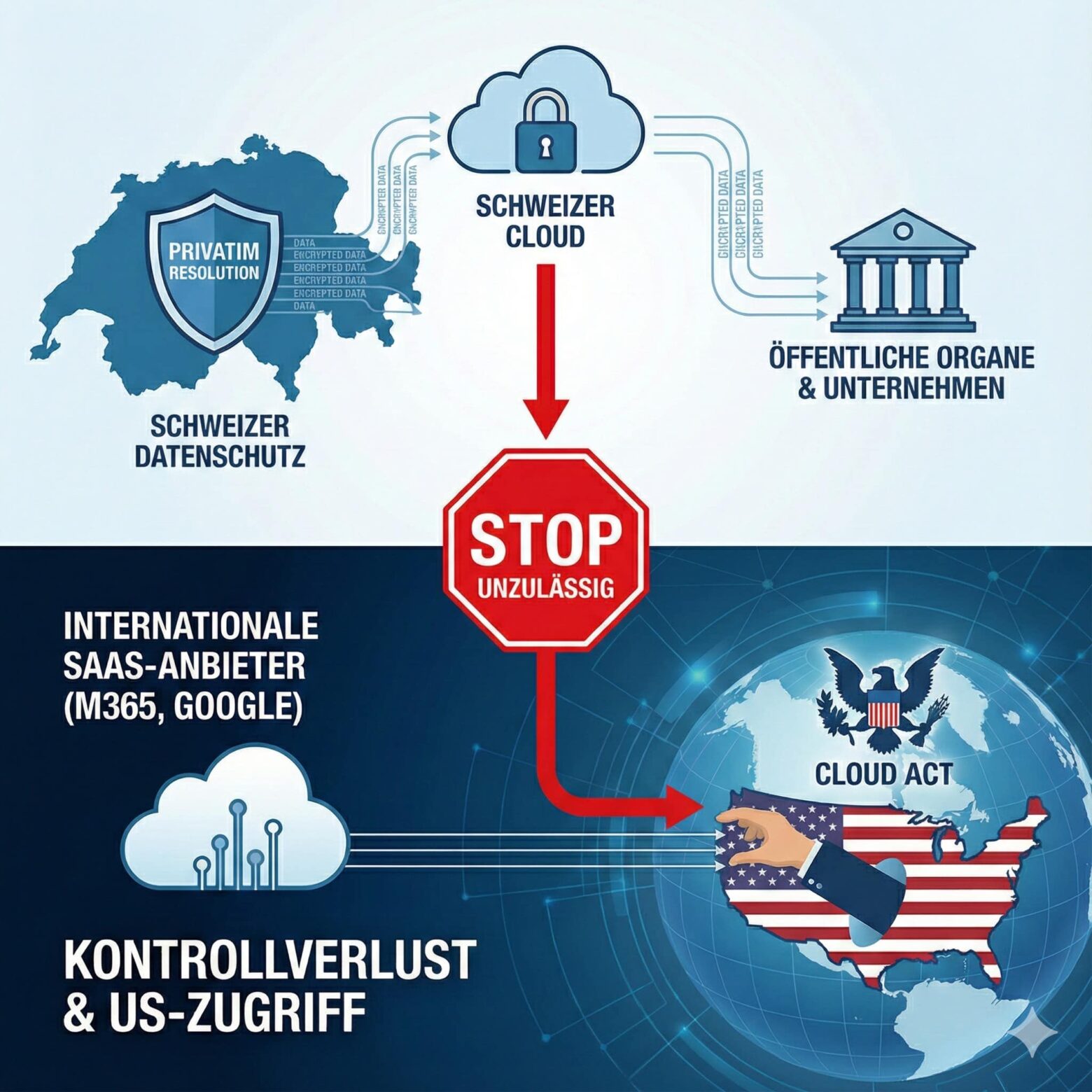
Die Konferenz der schweizerischen Datenschutzbeauftragten (privatim) hat am 24. November 2025 eine Resolution verabschiedet, die für Schweizer Behörden und Unternehmen das Aus für gängige internationale Cloud-Lösungen bedeuten könnte. Das Kernproblem: Microsoft 365, Google Workspace und ähnliche SaaS-Lösungen internationaler Anbieter sind für die Verarbeitung besonders schützenswerter Personendaten praktisch nicht zulässig.
Dies ist nicht nur eine technische Empfehlung, sondern auch eine rechtliche Klarstellung, die direkte Auswirkungen auf die digitale Infrastruktur des öffentlichen Sektors und zunehmend auch auf Private hat. Dies ist nicht nur ein schweizerisches Problem; im gesamten EU-Raum werden diverse Vorstöße unternommen, um gleichermaßen Stellung zu nehmen. Warum diese harte Haltung? Und welche praktischen Alternativen existieren bereits?
Der Kern der Resolution: Warum Microsoft 365 & Co. nicht mehr erlaubt sind
Das Kontrollverlust-Dilemma
Die privatim-Resolution identifiziert einen grundlegenden Widerspruch: Öffentliche Organe tragen eine besondere Verantwortung für Bürgerdaten. Werden diese in SaaS-Lösungen ausgelagert, entsteht ein massiver Kontrollverlust. Global operierende Konzerne wie Microsoft oder Google bieten nicht ausreichend Transparenz, um sicherzustellen, dass:
- Vertragliche Datenschutzverpflichtungen eingehalten werden (technische Massnahmen, Mitarbeiterkontrolle, Subunternehmer-Verwaltung)
- Softwareupdates und neue Features datenschutzkonform implementiert werden (die Anbieter ändern Bedingungen einseitig)
- Keine unkontrollierten Datenzugriffe durch interne oder externe Kräfte stattfinden
Schweizer Behörden haben keine Möglichkeit, diese Kontrollen effektiv durchzuführen – ein Zustand, der von privatim als rechtlich unzumutbar bewertet wird.
Das Cloud-Act-Risiko: US-Behörden greifen zu – auch bei Schweizer Daten
Ein entscheidender Faktor ist der US-amerikanische CLOUD Act von 2018. Dieser gestattet US-Behörden, von amerikanischen Tech-Konzernen Kundendaten zu erheben – ohne die Regeln der internationalen Rechtshilfe einzuhalten. Dies gilt auch für Daten, die in Schweizer Rechenzentren gespeichert sind.
Für Behörden, die unter Geheimhaltungspflichten (Amts- oder Berufsgeheimnis) stehen, ist dies nicht tragbar. Der CLOUD Act macht Schweizer Datenschutzgesetze de facto unwirksam.
Das Verschlüsselungs-Gap: Keine End-to-End-Verschlüsselung ohne Anbieterzugriff
Die meisten verfügbaren SaaS-Lösungen (inklusive M365, Google Workspace, Nextcloud Standard) bieten keine echte Ende-zu-Ende-Verschlüsselung, die den Anbieterzugriff auf Klartextdaten ausschliesst. Das heisst: Selbst wenn Daten «in der Schweiz» gespeichert sind, kann Microsoft oder Google sie lesen, analysieren – und unter dem CLOUD Act an US-Behörden weitergeben.
Die privatim-Lösung: Client-Side-Verschlüsselung als einziger Weg und eine Cloud Migration Schweiz
Die einzige erlaubte Regel für öffentliche Organe:
Besonders schützenswerte oder einer Geheimhaltungspflicht unterliegende Personendaten dürfen nur dann in Cloud-Lösungen ausgelagert werden, wenn:
- Der öffentliche Dienst die Daten selbst verschlüsselt (nicht der Cloud-Anbieter)
- Der Cloud-Anbieter keinen Zugang zum Verschlüsselungsschlüssel hat
Dies bedeutet praktisch: Client-Side-Encryption (Verschlüsselung auf dem Gerät des Nutzers vor dem Upload) ist nicht optional – sie ist zur Bedingung geworden.
Das Problem: Viele moderne SaaS-Tools funktionieren nur mit anbietersseitiger Verschlüsselung. Sie müssen Daten «lesen» können, um Suchen durchzuführen, Echtzeit-Zusammenarbeit zu ermöglichen oder automatische Backups zu schaffen. Mit Client-Side-Encryption fällt diese Funktionalität weg.
Was bedeutet das für Schweizer Unternehmen?
Behörden und öffentliche Organe: Sofortige Konsequenzen
Kantonale Verwaltungen, Gemeinden, Gerichte, Polizei und Schulen müssen ihre Microsoft-365- und Google-Workspace-Infrastrukturen überprüfen. Insbesondere:
- Personendaten von Bürgern (Steuerdaten, Sozialleistungen, Justizzakten, Patientendaten)
- Geheimhaltung unterliegende Daten (Kantonsratsunterlagen, Verhandlungen, interne Ermittlungen)
Diese dürfen nicht mehr in internationalen Public-Cloud-Lösungen liegen – es sei denn, sie sind durch Client-Side-Encryption geschützt. Empfehlung: Cloud Migration Schweiz
Private Unternehmen: Ein stilles Warnsignal
Während privatim nur öffentliche Organe direkt reguliert, ist die Botschaft für Private unmissverständlich: Wenn Ihr Unternehmen besonders schützenswerte Daten verarbeitet (Personalakten, Klientendossiers, Finanzdaten, Patientenakten), gelten dieselben Risiken. Die Resolution etabliert den neuen Standard für datenschutzkonforme Cloud-Nutzung in der Schweiz durch Cloud Migration Schweiz
Unternehmen, die sich nicht anpassen:
- Verspielen das Vertrauen ihrer Kunden und Mitarbeiter
- Riskieren Datenschutzbussen (bis zu 100’000 CHF für Privatpersonen, bis zu 6% des Umsatzes bei Behörden)
- Gefährden ihre Reputation in einem zunehmend datenschutzbewussten Markt
Die praktischen Alternativen: Cloud Migration Schweiz und europäische Cloud-Lösungen
Warum Cloud Migration Schweiz jetzt zur strategischen Notwendigkeit wird:
Die privatim-Resolution hat indirekt folgende Anforderungen an Cloud-Anbieter formuliert:
| Anforderung | Microsoft 365 | Schweizer Alternativen |
|---|---|---|
| Sitz des Anbieters | USA | Schweiz, EU |
| Datenspeicherung | USA + weltweit | Schweiz, EU |
| Client-Side-Encryption | Limitiert/Kostenpflichtig | Standard oder wählbar |
| Transparenzbericht | Gering | Regelmässig, unabhängig geprüft |
| CLOUD-Act-Schutz | Keine | Durch Schweizer Rechtssystem |
| Compliance-Audits | Eingeschränkt einsehbar | Offen, SOC 2, ISO 27001 |
Konkrete Lösungen, die die privatim-Anforderungen durch eine Cloud Migration Schweiz erfüllen:
- Infomaniak (Schweiz – eigene Rechenzentren)
- Komplett Schweizer Datenspeicherung
- Optional Client-Side-Encryption für vertrauliche Dateien
- DSGVO- und DSG-konform
- Unabhängig von US-amerikanischen Regulierungen
- Portfolio: kSuite Pro (E-Mail, Kalender, Dateiverwaltung, Video-Konferencing)
- OnlyOffice (als lokal gehostete Suite)
- Microsoft-Office-kompatible Funktionalität ohne Cloud-Abhängigkeit
- Open-Source, selbst verwaltbar
- ProtonMail / Proton Drive (Schweiz) / Nextcloud On-Premise (Deutschland, Schweiz als Optionen)
Cloud Migration Schweiz: Der praktische Weg von Microsoft und Co. zu Schweizer Lösungen
Viele Organisationen fragen sich: Wie geht das praktisch? Die Migration von Microsoft 365 zu Schweizer Lösungen folgt diesem Muster:
Phase 1: Analyse (2–4 Wochen)
- Welche Datentypen werden verarbeitet? (Besonders schützenswert?) Geheimhaltungspflichtig?)
- Welche Microsoft-Services sind im Einsatz? (E-Mail, Teams, OneDrive, SharePoint, etc.)
- Wie viele Mitarbeiter und Lizenzen sind betroffen?
Phase 2: Pilotmigration (4–8 Wochen)
- Auswahl einer Pilotgruppe (meist IT-Team, HR-Abteilung)
- Test der Infomaniak/Proton-Lösungen mit echten Workflows
- Evaluation von Funktionslücken (z. B. Teams-Ersatz durch kConf-Videokonferencing)
Phase 3: Vollmigration (2–6 Monate)
- Schrittweise Umstellung pro Abteilung
- Parallel-Betrieb zur Sicherstellung von Datenkontinuität
- Mitarbeiterschulung und Change Management
Phase 4: Cloud-Act-Sicherheit
- Implementierung von Client-Side-Encryption für besonders schützenswerte Dateien
- Datenschutz-Folgeabschätzung (DPIA) durchführen
- Vertragswerk mit neuem Anbieter finalisieren
Der praktische Partner für Ihre Cloud Migration Schweiz – Office2SwissCloud.ch
Die Theorie ist klar. Die Anforderung an die Privatim-Resolution ist unmissverständlich. Aber wie setzen Sie das in der Praxis um – ohne dabei den Geschäftsbetrieb zu gefährden?
Genau hier setzt Office2SwissCloud an. Als spezialisierter Berater und Implementierungspartner begleitet Office2SwissCloud Organisationen und Privatpersonen auf dem gesamten Weg von Microsoft, Google oder Apple zu sicheren Schweizer Cloud-Lösungen bei Infomaniak – mit null Kompromissen bei Datenschutz, Compliance und Unabhängigkeit.
Was Office2SwissCloud leistet:
1. Analyse Ihrer bestehenden Umgebung
- Gründliche Evaluation Ihrer IT-Infrastruktur
- Klassifizierung der Datentypen (besonders schützenswert? Geheimhaltungspflichtig?)
- Bestimmung der technischen Anforderungen für die Migration
- Beratung zu Alternativen und passenden Schweizer Lösungen
2. Aufbau der neuen Cloud-Infrastruktur
- Sichere und reibungslose Migration aller Daten (E-Mail, Dateien, Kalender, Kontakte, Videokonferenzen)
- Konfiguration von Infomaniak kSuite Pro mit Client-Side-Encryption wo nötig
- Integration nicht-proprietärer Office-Anwendungen (OnlyOffice)
- Sichere Datenübertragung mit vollständiger Integrität
3. Inbetriebnahme und Schulung
- Überprüfung aller migrierten Daten
- Kompetente Schulung Ihrer Mitarbeiter
- Continuous Support und Optimierung
- Dokumentation für künftige Wartung
4. Kontinuierliche Betreuung
- Technischer Support nach der Migration
- Unterstützung bei neuen Anforderungen
- Compliance-Dokumentation und Datenschutz-Folgeabschätzungen
- Langfristige Sicherheit und Optimierung
Warum Office2SwissCloud?
- Schweizer Expertise: Tiefes Verständnis für Schweizer Datenschutz (DSGVO, FINMA-Richtlinien, privatim-Anforderungen)
- Geprüfte Infomaniak-Kompetenz: zertifizierter Partner mit umfassender Erfahrung in Infomaniak-Migrationen
- Kein Vendor-Lock-In: Offene, nicht proprietäre Lösungen – Ihre Daten bleiben Ihrer Kontrolle unterworfen
- Für Behörden und Privatunternehmen: Erfahrung mit öffentlichen Organen, KMU und Privatpersonen
Cloud Migration Schweiz: Kosten und Transparenz
Eine häufig gestellte Frage: Wie teuer ist eine Migration?
Die gute Nachricht: Der erste Beratungstermin ist kostenlos. Office2SwissCloud hilft Ihnen, die Komplexität und den Umfang zu verstehen, bevor Sie sich zu Investitionen verpflichten.
Die Kosten einer Migration hängen ab von:
- Anzahl der Benutzer
- Datenmenge (E-Mail-Archive, Dateien, etc.)
- Komplexität der integrierten Systeme
- Schulungsbedarf
Realistisches Beispiel für ein 20-Personen-KMU:
- Consulting & Analyse: CHF 2.000–4.000
- Migration & Aufbau: CHF 3.000–6.000
- Schulung & Inbetriebnahme: CHF 2.000–3.000
- Total: CHF 7.000–13.000 (einmalig)
Im Vergleich: Langfristige Compliance-Risiken, Datenschutzbussen und erzwungene Notfallmigrationen können ein Vielfaches kosten.
Häufig gestellte Fragen (FAQ) – Von der privatim-Resolution zur praktischen Umsetzung
F: Gilt die Privatim-Resolution auch für mein privates Unternehmen?
A: Nicht direkt – privatim reguliert öffentliche Organe. Aber die Anforderungen gelten indirekt: Wenn Ihr Unternehmen schützenswerte Daten (Personalakten, Klientendossiers, Patientenakten) verarbeitet, sind Sie de facto verpflichtet, dieselben Sicherheitsstandards zu erfüllen. Der CLOUD Act betrifft alle, nicht nur Behörden. Office2SwissCloud berät Sie, ob die Resolution Ihre Organisation direkt betrifft.
F: Kann ich Infomaniak selbst einrichten, oder brauche ich einen Berater?
A: Technisch ist Infomaniak benutzerfreundlich. Aber eine professionelle Migration hat massive Vorteile:
- Datensicherheit: Keine Datenverluste bei der Übertragung
- Compliance: Dokumentation für Datenschutz-Audits
- Mitarbeiterzufriedenheit: Strukturierte Schulung statt Selbstversuch
- Zeiteffizienz: Expert-Setup vs. Wochen von Selbstversuch
Office2SwissCloud spart Ihnen diese Zeit und das Risiko.
F: Wie lange bin ich ohne den Dienst während der Migration?
A: Mit einem professionellen Ansatz: Praktisch keine Ausfallzeit. Office2SwissCloud arbeitet mit Parallel-Betrieb – die alte Infrastruktur läuft weiter, während die neue aufgebaut wird. Dann folgt ein sanfter Switchover.
F: Was passiert mit meinen E-Mails und OneDrive/Google Drive etc. -Dateien?
A: Alles wird migriert. Office2SwissCloud stellt sicher, dass:
- Alle E-Mail-Archive von Gmail/Outlook erhalten bleiben
- Alle OneDrive/SharePoint-Dateien in Infomaniak kDrive übertragen werden
- Kalender, Kontakte und Notizen synchronisiert werden
- Berechtigungen und Freigaben korrekt rekonstruiert werden
F: Kann ich die Migration in Etappen durchführen?
A: Ja, absolut. Office2SwissCloud kann mit Abteilungen oder sogar Einzelpersonen starten – in einer Pilotphase. Das reduziert das Risiko und ermöglicht Teams, die neue Lösung vor dem unternehmensweiten Rollout zu testen.
Nächste Schritte – Ihre Reise zur Unabhängigkeit beginnt mit einem Gespräch
Die privatim-Resolution ist kein vages Ideal – sie ist ein regulatorisches Signal. Organisationen, die sich heute vorbereiten, vermeiden morgen Probleme.
So starten Sie:
1. Kostenloses Erstgespräch buchen
Kontaktieren Sie Office2SwissCloud für eine unverbindliche Beratung. Sie erhalten eine ehrliche Einschätzung Ihrer aktuellen Situation sowie Ihrer Migrationsoptionen.
2. Analyse durchführen lassen
Office2SwissCloud führt eine gründliche Analyse Ihrer IT-Umgebung durch – kostenlos oder mit minimalem Aufwand. Sie erhalten anschließend ein konkretes Migrationsangebot.
3. Pilotprojekt starten
Weniger Risiko mit einem Pilot: Testen Sie die Infomaniak-Lösung mit einem kleinen Team, bevor Sie unternehmensweit migrieren.
4. Vollmigration planen
Sobald der Pilot erfolgreich ist, planen Sie die schrittweise vollständige Migration – mit minimalem Geschäftsrisiko.
Kontaktieren Sie Office2SwissCloud heute:
🔒 Schweizer Datenschutz. 100% Unabhängigkeit. Keine Cloud-Act-Risiken.
📧 Schreiben Sie uns : thomas.marx@office2swissscloud.ch
📧 Besuchen Sie office2swisscloud.ch für:
- Detaillierte Informationen über Migrationsservices
- Kundenerfahrungen und Erfolgsgeschichten
- FAQ zu Infomaniak und Schweizer Cloud-Lösungen
- Kostenlose Erstberatung buchen
Die Zeit zum Handeln ist jetzt. Die Privatim-Resolution zeigt: Schweizer Datenschützer erwarten Unabhängigkeit – nicht irgendwann, sondern heute. Office2SwissCloud ist Ihr Partner auf diesem Weg.
Die wirtschaftliche Perspektive: Warum Cloud Migration Schweiz wirtschaftlich sinnvoll ist
Häufig wird argumentiert: «Microsoft ist billiger.» Das ist so nicht richtig – die versteckten Kosten der fehlenden Datensicherheit sind erheblich:
Risiken von Microsoft 365 für Schweizer Behörden:
- Potenzielle Datenschutzbussen (Folge von CLOUD-Act-Zugriffen)
- Reputationsschaden durch öffentliche Datenpannen
- Kosten von forensischen Untersuchungen und Notfall-Kommunikation
- Künftige erzwungene Migration (wenn die Regulierung verschärft wird)
Die langfristige Strategie: Digitale Souveränität für die Schweiz
Die privatim-Resolution ist Teil einer grösseren europäischen Bewegung. Länder wie Frankreich (Gaia-X Initiative), Deutschland (Sovereign Cloud) und jetzt auch die Schweiz investieren in digitale Unabhängigkeit von US-Plattformen.
Die Schweiz positioniert sich dabei als:
- Datenschutz-Vorreiter (DSGVO-ähnliche Regulierung seit 1992)
- Sicherer Hafen für Daten (Rechtsstaatlichkeit, politische Neutralität)
- Wirtschaftlicher Standort für Cloud-Innovation (Infomaniak, Proton, Nextcloud-Communities)
Unternehmen, die diese Entwicklung früh annehmen, gewinnen:
- Wettbewerbsvorteil: Kunden vertrauen Schweizer Datenverarbeitung
- Zukunftssicherheit: Keine erzwungenen Migrationen mehr
- Unabhängigkeit: Weniger Abhängigkeit von US-Konzern-Updates und Richtlinienwechseln
Handlungsempfehlungen für 2026
Für öffentliche Organe:
- ✓ Audit durchführen: Welche Daten liegen aktuell in Microsoft 365/Google Workspace?
- ✓ Klassifizieren: Welche sind besonders schützenswert oder geheimhaltungspflichtig?
- ✓ Pilotprojekt starten: Migration zu Infomaniak kSuite oder ProtonMail testen
- ✓ Compliance dokumentieren: Datenschutz-Folgeabschätzung (DPIA) durchführen
Für private Unternehmen:
- ✓ Datenschutz-Selbstcheck: Betreffe ich die Anforderungen der Resolution indirekt?
- ✓ Vergleichen: Infomaniak, Proton, Nextcloud On-Premise evaluieren
- ✓ Marktzugang: Welche Kunden erwarten Schweizer Datenspeicherung?
- ✓ Zukunftsfähig investieren: Schweizer Cloud-Lösungen reduzieren Compliance-Risiken
Fazit: Der CLOUD Act zwingt die Schweiz zur Aktion
Die Privatim-Resolution vom 24. November 2025 markiert einen Wendepunkt. Der amerikanische CLOUD Act hat für Schweizer Datenschützer bewiesen, dass US-Cloud-Anbieter nicht ausreichend Kontrolle und Transparenz bieten. Die Reaktion ist klar: Für sensible Daten braucht die Schweiz Schweizer Clouds.
Das ist technisch nicht unmöglich – es ist politisch und wirtschaftlich längst überfällig. Infomaniak und andere Schweizer Anbieter verfügen über die Infrastruktur und die Expertise, um den Bedarf zu decken. Der CLOUD Act wird nicht verschwinden, aber Schweizer Unternehmen können sich von ihm befreien – durch digitale Souveränität.